

The global coconut charcoal market continues to gain momentum as industries worldwide shift toward sustainable energy sources and premium fuel alternatives. Driven by growing demand from shisha, BBQ, and industrial sectors, coconut charcoal has evolved into a strategic commodity in international trade. Understanding global demand patterns and market dynamics is essential for buyers and decision-makers navigating this competitive industry.
This market insight explores the global coconut charcoal landscape, highlighting key demand drivers, long-term industry trends, and Indonesia’s position as a leading supplier. Backed by deep industry knowledge and export experience, Madika Coconut Indonesia plays an active role in connecting global buyers with reliable Indonesian producers. Through this overview, readers gain strategic perspective to support informed sourcing and partnership decisions.
QUICK VIEW
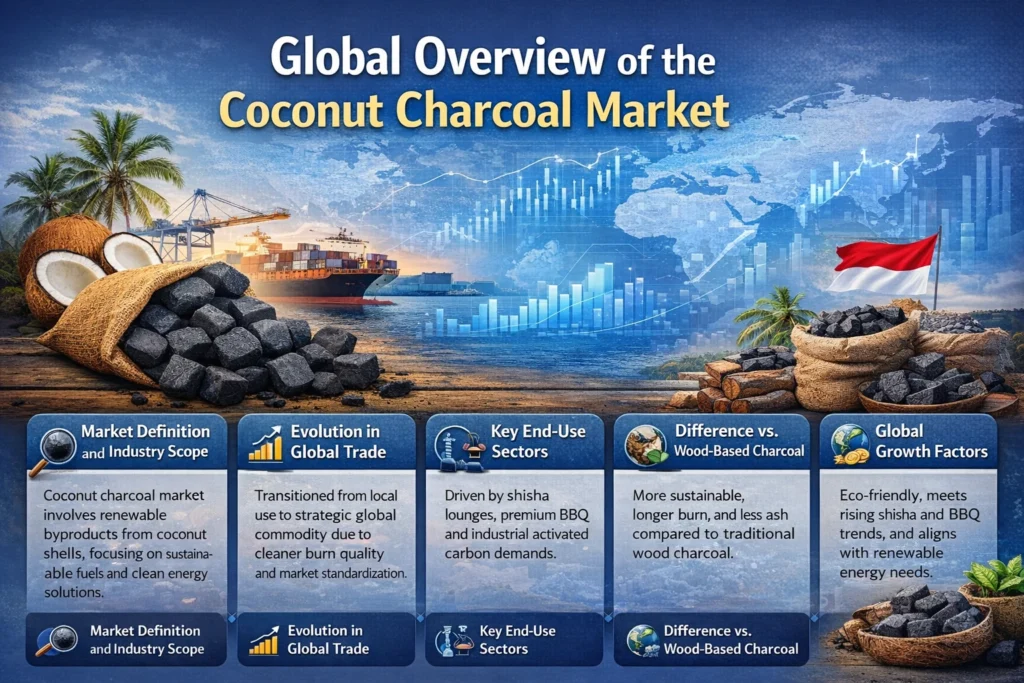
Global Overview of the Coconut Charcoal Market

Market Definition and Industry Scope
The coconut charcoal market refers to the global industry centered on charcoal products derived from coconut shells, a renewable agricultural byproduct. Unlike conventional charcoal markets, this sector is closely linked to sustainability, waste utilization, and clean-energy narratives. Coconut charcoal is widely recognized for its high carbon content, low ash residue, and consistent burning performance.
The industry scope extends beyond household fuel, encompassing premium shisha, barbecue applications, and industrial uses such as activated carbon production. These diverse applications position coconut charcoal as both a consumer product and an industrial raw material. As a result, market dynamics are influenced by lifestyle trends, industrial demand, and environmental policies simultaneously.
From a global perspective, the coconut charcoal market operates at the intersection of agriculture, manufacturing, and international trade. Its value chain connects coconut-producing regions with high-demand markets across Asia, the Middle East, Europe, and beyond. This broad scope makes coconut charcoal a strategic commodity rather than a niche fuel product.
Evolution of Coconut Charcoal in Global Trade
Coconut charcoal initially emerged as a localized fuel solution in coconut-producing regions, primarily used for household cooking. Over time, improvements in carbonization techniques and product standardization enabled it to enter international trade. This transition marked the beginning of coconut charcoal’s role in global commodity markets.
The expansion of shisha culture and premium grilling significantly accelerated international demand. As consumers sought cleaner-burning and longer-lasting fuel alternatives, coconut charcoal gained a competitive edge over traditional wood charcoal. Export-oriented production hubs gradually formed in regions with abundant coconut resources and established logistics infrastructure.
Today, coconut charcoal is traded globally as a differentiated product rather than a basic fuel. Its evolution reflects broader shifts in global trade toward sustainable materials, value-added processing, and specialized end-use markets. This transformation continues to shape pricing structures, buyer expectations, and supplier competitiveness.
Key End-Use Sectors Driving Global Demand
One of the primary demand drivers for coconut charcoal is the shisha industry, where consistent heat, long burn time, and low ash content are essential. Shisha lounges and distributors prioritize fuel quality to maintain flavor integrity and customer experience. This sector has become a cornerstone of global coconut charcoal demand.
The premium barbecue and grilling segment also contributes significantly to market growth. Restaurants, hospitality businesses, and high-end consumers increasingly favor coconut charcoal for its clean combustion and minimal smoke. These characteristics align with modern culinary standards and sustainability-focused branding.
Beyond consumer markets, industrial demand plays a crucial role, particularly in activated carbon production. Coconut shell charcoal is a preferred feedstock due to its microporous structure, making it suitable for water purification, air filtration, and food processing applications. This industrial usage adds stability and long-term demand depth to the market.
Difference Between Coconut Charcoal and Wood-Based Charcoal
Coconut charcoal differs fundamentally from wood-based charcoal in terms of raw material and performance characteristics. Produced from coconut shells, it utilizes an agricultural byproduct rather than harvested timber. This distinction positions coconut charcoal as a more sustainable alternative within global energy and fuel markets.
In terms of performance, coconut charcoal typically offers higher fixed carbon levels and significantly lower ash content. These properties result in longer burn duration, steadier heat output, and reduced residue after use. Such advantages are particularly valued in premium and professional applications.
From a market standpoint, these differences influence buyer perception and pricing. Coconut charcoal is often categorized as a premium product, while wood-based charcoal occupies a broader mass-market segment. This differentiation supports higher value positioning and reinforces coconut charcoal’s role in quality-driven global markets.
Why Coconut Charcoal Is Gaining Global Attention
Global attention toward coconut charcoal is closely tied to rising sustainability awareness and environmental responsibility. As governments, businesses, and consumers seek alternatives to deforestation-linked fuels, coconut charcoal stands out as a renewable and low-impact option. Its production aligns with circular economy principles by converting waste into value.
At the same time, lifestyle trends such as premium dining, specialty grilling, and shisha culture continue to expand across regions. These trends favor fuels that deliver consistent performance and aesthetic cleanliness, both of which are hallmarks of coconut charcoal. Market demand is therefore driven by both ethical considerations and practical benefits.
Combined, these factors elevate coconut charcoal from a traditional fuel to a globally relevant commodity. Its growing visibility reflects broader shifts in energy use, consumer preference, and sustainable trade practices. As these dynamics persist, coconut charcoal is expected to remain a focal point of global market discussions.
Global Demand Drivers and Buyer Behavior
Sustainability and Renewable Energy Adoption
Sustainability has become one of the most influential demand drivers in the global coconut charcoal market. As governments and corporations commit to reducing carbon footprints, renewable and low-impact fuel alternatives gain strategic importance. Coconut charcoal, produced from agricultural waste, aligns well with global sustainability and circular economy initiatives.
Unlike wood-based charcoal, coconut charcoal does not rely on deforestation-linked raw materials. This distinction is increasingly relevant for buyers operating under environmental regulations or sustainability reporting frameworks. As a result, procurement decisions are no longer based solely on price, but also on environmental credentials.
For many buyers, especially in developed markets, sustainability has shifted from a marketing advantage to a purchasing requirement. Coconut charcoal’s renewable profile positions it as a preferred fuel option in regions where environmental responsibility directly influences sourcing strategies.
Growth of Shisha and Premium BBQ Markets
The expansion of shisha culture across the Middle East, Europe, and parts of Asia has significantly boosted global demand for coconut charcoal. Shisha operators prioritize fuel that delivers consistent heat, extended burn time, and minimal ash to preserve flavor quality. Coconut charcoal meets these requirements more effectively than most alternatives.
In parallel, premium barbecue and grilling markets continue to grow, driven by lifestyle trends and higher consumer expectations. Restaurants, catering businesses, and specialty BBQ brands increasingly favor coconut charcoal for its clean combustion and steady performance. These qualities support both operational efficiency and premium brand positioning.
Combined, the shisha and premium BBQ segments represent a stable and high-value demand base. Their reliance on quality rather than volume alone reinforces coconut charcoal’s positioning as a premium commodity within global fuel markets.
Industrial Demand for Activated Carbon Applications
Beyond consumer-facing markets, industrial demand plays a critical role in shaping global coconut charcoal consumption. Coconut shell charcoal is widely used as a feedstock for activated carbon production due to its high microporosity and carbon content. This makes it suitable for advanced filtration and purification processes.
Activated carbon derived from coconut shells is essential in water treatment, air purification, food processing, and pharmaceutical applications. These industries operate under strict quality and performance standards, creating consistent and long-term demand for high-grade raw charcoal. Industrial buyers often value reliability and material consistency over short-term price fluctuations.
This industrial usage adds resilience to the coconut charcoal market. While consumer demand may fluctuate with lifestyle trends, industrial applications provide a steady baseline that supports long-term market stability.
Changing Buyer Preferences and Quality Expectations
Global buyers have become increasingly selective in their sourcing decisions, with quality consistency emerging as a top priority. Rather than purchasing generic charcoal products, buyers now seek clearly defined specifications related to carbon content, ash levels, moisture, and burn performance. This shift reflects a broader professionalization of the market.
Packaging standards, product uniformity, and traceability also influence buyer preferences. Importers serving premium markets require predictable performance across shipments to protect their downstream customers and brand reputation. As a result, suppliers capable of meeting consistent quality benchmarks gain a competitive advantage.
This evolution in buyer behavior has elevated coconut charcoal from a bulk commodity to a specification-driven product. Quality assurance and reliability now play a central role in shaping long-term buyer–supplier relationships.
Long-Term Demand Patterns Across Regions
Global demand for coconut charcoal is not evenly distributed, with distinct patterns emerging across regions. The Middle East remains a dominant market due to strong shisha consumption, while Europe shows growing demand driven by sustainability-focused regulations and premium BBQ culture. East Asia contributes through both consumer use and industrial applications.
These regional differences influence product preferences, quality requirements, and purchasing cycles. Buyers in mature markets often prioritize certification and sustainability credentials, while emerging markets may focus more on performance and pricing balance. Understanding these nuances is essential for interpreting global demand trends.
Over the long term, regional diversification strengthens the overall market outlook. As demand expands across multiple geographies and applications, the coconut charcoal industry becomes less dependent on a single sector or region, supporting sustained global growth.
Major Producing Countries and Global Supply Landscape
Key Coconut-Producing Regions Worldwide
Global coconut charcoal production is closely tied to regions with abundant coconut cultivation, primarily located in tropical and subtropical zones. Southeast Asia remains the most prominent coconut-producing area, supported by favorable climate conditions and long-established agricultural practices. Countries in this region benefit from year-round coconut harvesting, which supports continuous raw material supply.
South Asia and parts of the Pacific also contribute to global coconut output, although production volumes and export orientation vary widely. In many of these regions, coconuts are used primarily for food and oil industries, with charcoal production playing a secondary role. This limits their ability to scale consistently for international charcoal markets.
A smaller share of coconut charcoal supply comes from regions in Africa and Latin America where coconut farming exists but remains less integrated into global charcoal trade. As demand grows, these regions are increasingly explored for future supply diversification, although infrastructure and processing capacity remain key constraints.
Comparative Overview of Major Exporting Countries
Among exporting countries, differences in scale, consistency, and market orientation are clearly visible. Some producers focus on regional or domestic markets, while others have developed export-focused ecosystems capable of serving international buyers. These distinctions influence product standardization, pricing structures, and long-term reliability.
Leading exporters are typically characterized by strong integration between raw material sourcing, manufacturing, and logistics. This integration allows them to respond efficiently to global demand shifts and buyer requirements. Countries with fragmented supply chains often struggle to maintain consistent export volumes.
From a buyer’s perspective, comparative evaluation goes beyond production capacity alone. Factors such as historical export performance, regulatory compliance, and supplier professionalism play a central role in determining preferred sourcing destinations within the global coconut charcoal market.
Raw Material Availability and Production Ecosystems
Raw material availability is a fundamental determinant of supply stability in the coconut charcoal industry. Coconut shells are generated as byproducts from food and oil processing, linking charcoal production to broader coconut-based industries. Regions with diversified coconut processing activities benefit from steady shell availability.
Production ecosystems that integrate shell collection, carbonization, and downstream processing tend to be more resilient. These ecosystems reduce dependency on single suppliers and minimize disruptions caused by seasonal or logistical challenges. In contrast, isolated or informal production setups face greater volatility.
The maturity of production ecosystems also influences scalability. Well-established networks can expand output in response to rising demand, while less developed systems encounter bottlenecks related to labor, equipment, and infrastructure. This disparity shapes long-term supply competitiveness across producing countries.
Quality Consistency and Manufacturing Capabilities
Quality consistency is a defining factor that differentiates global coconut charcoal suppliers. Manufacturing capabilities vary significantly depending on technology adoption, process control, and operational expertise. Suppliers with standardized production methods are better positioned to meet international quality expectations.
Manufacturing consistency affects key product attributes such as carbon content, ash level, moisture, and burn performance. Variability in these factors can disrupt downstream use, particularly in premium and industrial applications. Buyers therefore prioritize suppliers with proven quality management practices.
Over time, manufacturing capability has become a competitive advantage rather than a basic requirement. As buyer expectations rise, suppliers investing in process optimization and quality assurance strengthen their position within the global supply landscape.
Structural Factors Influencing Global Supply Stability
Global supply stability in the coconut charcoal market is shaped by a combination of structural factors. Agricultural cycles, climate variability, and competing uses for coconut byproducts can all affect raw material availability. These elements introduce inherent variability into the supply chain.
In addition, infrastructure quality and industrial organization play a significant role. Regions with reliable transportation networks, energy access, and processing facilities are better equipped to maintain consistent production and delivery schedules. Structural inefficiencies can amplify supply disruptions during periods of high demand.
Understanding these structural factors is essential for interpreting long-term market dynamics. Supply stability is not solely determined by production volume, but by the resilience of the entire ecosystem supporting coconut charcoal manufacturing and trade.
Indonesia’s Position in the Global Coconut Charcoal Market
Abundant Coconut Resources and Year-Round Supply
Indonesia holds a strong structural advantage in the global coconut charcoal market due to its vast coconut cultivation areas. As one of the world’s largest coconut producers, the country generates a continuous supply of coconut shells as agricultural byproducts. This abundance forms a reliable foundation for large-scale and sustained charcoal production.
Unlike regions that depend on seasonal harvest cycles, Indonesia benefits from year-round coconut availability. This continuous supply reduces production interruptions and enables manufacturers to maintain stable output levels. For global buyers, such consistency is a critical factor in long-term sourcing decisions.
The availability of raw materials across multiple islands also supports geographic diversification within the supply base. This reduces dependency on a single production area and enhances overall resilience against localized disruptions.
Manufacturing Experience and Export-Oriented Production
Indonesia’s coconut charcoal industry has developed through decades of manufacturing experience and exposure to international markets. Many producers have evolved from small-scale operations into export-oriented manufacturers capable of meeting global demand. This transition reflects accumulated technical knowledge and operational maturity.
Export-oriented production has shaped manufacturing practices toward standardization and efficiency. Producers increasingly align output with international specifications to serve professional buyers rather than local markets alone. This focus strengthens Indonesia’s reputation as a dependable sourcing destination.
The presence of experienced exporters also contributes to market confidence. Buyers often favor suppliers from countries with a proven export track record, as it reduces perceived risk related to communication, consistency, and long-term cooperation.
Quality Standards and Product Specialization
Quality differentiation is a defining feature of Indonesian coconut charcoal within the global market. Producers commonly specialize in specific product types designed for distinct end-use applications, such as shisha, barbecue, or industrial processing. This specialization enables closer alignment with buyer expectations.
Standardized quality benchmarks related to carbon content, ash levels, moisture, and burn performance are increasingly integrated into production systems. Maintaining these benchmarks across shipments is essential for serving premium and industrial buyers. Consistency reinforces trust and repeat purchasing behavior.
Product specialization also supports value positioning. Rather than competing solely on price, Indonesian suppliers often compete on performance, reliability, and suitability for specific applications, strengthening their competitive standing in global markets.
Logistics Infrastructure and Global Market Access
Indonesia’s strategic location and established maritime infrastructure support efficient access to major global markets. Well-developed port facilities enable regular shipping routes to Asia, the Middle East, Europe, and other key importing regions. This connectivity enhances Indonesia’s role in international trade flows.
Integrated logistics networks connecting production centers, warehouses, and ports further improve supply reliability. Efficient coordination between manufacturing and logistics reduces lead times and minimizes handling risks. These factors are particularly important for buyers operating on fixed delivery schedules.
Reliable global market access strengthens Indonesia’s appeal as a sourcing hub. Buyers value suppliers that can consistently deliver across long distances without compromising product integrity or timing.
Why Global Buyers Prefer Indonesian Coconut Charcoal
Global buyers increasingly prefer Indonesian coconut charcoal due to a combination of supply reliability, product consistency, and market experience. The ability to source from a country with abundant raw materials and established manufacturing capacity reduces procurement risk. This reliability supports long-term sourcing strategies.
In addition, Indonesian suppliers are widely associated with quality-driven production rather than opportunistic trading. Buyers serving premium segments value predictable performance and professional engagement throughout the supply relationship. These attributes influence repeat purchasing decisions.
Ultimately, Indonesia’s position is defined not by a single advantage but by an integrated ecosystem. The alignment of resources, manufacturing capability, logistics access, and market orientation positions Indonesia as a leading player in the global coconut charcoal market.
Market Trends Shaping the Coconut Charcoal Industry
Premium Briquette Innovations and Product Differentiation
Product innovation has become a defining trend in the coconut charcoal industry as buyers demand higher performance and greater consistency. Premium briquette designs are developed to optimize burn time, heat stability, and visual uniformity. These innovations reflect the industry’s shift toward specification-driven markets.
Different briquette formats are tailored to distinct applications, allowing suppliers to serve specialized buyer segments more effectively. Rather than offering generic products, manufacturers increasingly focus on differentiation through performance characteristics. This approach supports premium positioning and long-term customer retention.
As competition intensifies, innovation functions as a strategic lever rather than a technical upgrade. Suppliers capable of aligning product design with end-use expectations strengthen their relevance within global markets.
Regulatory and Sustainability Compliance Trends
Regulatory scrutiny and sustainability standards are playing an increasingly important role in shaping the coconut charcoal industry. Buyers operating in regulated markets face growing pressure to demonstrate environmental responsibility and ethical sourcing. Compliance has therefore become a key factor in supplier selection.
Sustainability requirements extend beyond raw material origin to include production practices, emissions control, and traceability. Suppliers able to align with these expectations reduce compliance risks for their buyers. This alignment supports long-term trade relationships in regulated regions.
As regulations evolve, compliance is no longer viewed as a constraint but as a market entry requirement. Suppliers that proactively adapt to sustainability standards gain strategic advantage in global trade.
Regional Demand Shifts and Emerging Buyer Markets
Global demand for coconut charcoal continues to shift geographically as consumption patterns evolve. Established markets maintain steady demand, while emerging regions contribute incremental growth. These shifts diversify the industry’s demand base.
Emerging buyer markets often display different purchasing priorities, balancing performance requirements with cost considerations. Suppliers capable of understanding and adapting to these regional nuances are better positioned to expand their market reach. Flexibility becomes a competitive asset.
Over time, regional diversification reduces dependency on a limited number of markets. This broadening demand landscape enhances overall industry resilience and supports long-term growth.
Pricing Dynamics and Market Volatility Factors
Pricing in the coconut charcoal market is influenced by multiple interacting factors, including raw material availability, energy costs, and global demand fluctuations. Unlike standardized commodities, coconut charcoal pricing reflects product quality and application specificity. This creates a more complex pricing environment.
Short-term volatility may arise from supply disruptions or sudden demand shifts, particularly in premium segments. Buyers and suppliers increasingly seek stable partnerships to mitigate these fluctuations. Long-term agreements help balance price stability with market responsiveness.
Understanding pricing dynamics requires a holistic view of supply chains rather than isolated cost components. Market insight allows stakeholders to anticipate volatility and make informed pricing decisions.
Digitalization and Transparency in Global Trade
Digitalization is gradually reshaping how coconut charcoal is traded and sourced globally. Enhanced communication tools and data sharing improve coordination between buyers and suppliers. Transparency has become an expectation rather than an added benefit.
Buyers increasingly value visibility into sourcing practices, production standards, and supply reliability. Digital documentation and traceability systems help build trust across international transactions. These tools reduce information asymmetry and transactional risk.
As digital adoption expands, transparency strengthens market efficiency. Suppliers that embrace digital practices align more closely with modern buyer expectations and global trade standards.
While this article focuses on long-term market dynamics and structural demand drivers, global coconut charcoal demand can vary from year to year due to trade conditions, buyer behavior, and regional consumption patterns. For a more detailed annual perspective, see our Global Demand for Indonesian Coconut Charcoal 2025, which provides data-driven insights into export trends, major buyer markets, and short-term demand developments.
Global Market Outlook and Industry Direction
Long-Term Growth Potential Beyond Annual Cycles
The long-term outlook for the coconut charcoal market is shaped by structural demand drivers rather than short-term cycles. Sustainability, lifestyle changes, and industrial applications continue to support steady growth. These factors extend beyond annual market fluctuations.
Unlike trend-dependent commodities, coconut charcoal benefits from diverse end-use sectors. This diversification supports demand continuity even as individual segments experience variation. Long-term growth is therefore grounded in market fundamentals.
Viewing the industry through a multi-year lens provides clearer insight into its growth trajectory. Strategic planning based on long-term trends offers greater value than short-term forecasting alone.
Risks and Challenges Facing Global Suppliers
Despite positive outlooks, global suppliers face a range of challenges that influence market stability. Supply chain disruptions, regulatory changes, and cost pressures can affect production and delivery. These risks require proactive management.
Operational challenges also arise from quality consistency and resource availability. Suppliers lacking integrated production ecosystems may struggle to maintain reliability. These constraints can limit scalability and competitiveness.
Recognizing these risks is essential for realistic market assessment. Effective risk management strengthens supplier credibility and supports sustained participation in global markets.
Opportunities for Indonesian Exporters
Indonesia’s established position in the coconut charcoal market creates significant opportunities for future expansion. Growing demand for sustainable and high-performance fuel alternatives aligns with Indonesia’s production strengths. This alignment supports continued market relevance.
Opportunities extend beyond volume growth to include product specialization and value positioning. Indonesian exporters capable of meeting evolving buyer expectations can deepen market penetration. Strategic differentiation enhances long-term competitiveness.
By aligning production capabilities with global trends, Indonesian suppliers can reinforce their leadership position. Market insight plays a key role in identifying and capturing these opportunities.
Strategic Implications for Global Buyers
For global buyers, understanding market direction is essential for informed sourcing strategies. Long-term demand drivers and supply dynamics influence procurement planning. Market insight helps buyers anticipate change rather than react to it.
Strategic sourcing decisions increasingly consider sustainability, reliability, and partnership potential. Buyers who align with capable suppliers reduce operational risk. This strategic approach supports business continuity.
Informed buyers leverage market insight to balance cost, quality, and long-term supply security. Such decision-making strengthens resilience within competitive markets.
How Market Insight Supports Informed Sourcing Decisions
Market insight provides a structured understanding of industry dynamics that goes beyond transactional considerations. It connects demand drivers, supply capabilities, and long-term trends into a coherent perspective. This clarity supports strategic decision-making.
Rather than focusing solely on immediate needs, informed sourcing considers future market conditions. Insight-driven decisions help buyers anticipate shifts in demand, regulation, and supply availability. This foresight reduces uncertainty.
Ultimately, market insight transforms sourcing from a reactive process into a strategic function. By grounding decisions in comprehensive market understanding, buyers and suppliers alike strengthen their position within the global coconut charcoal industry.
FAQ About Global Coconut Charcoal Market Insight
What is the global coconut charcoal market?
The global coconut charcoal market refers to the international trade and consumption of charcoal produced from coconut shells. It serves various sectors including shisha, premium BBQ, and industrial applications such as activated carbon production.
What drives global demand for coconut charcoal?
Global demand is driven by sustainability trends, growth in shisha and premium BBQ markets, and increasing industrial use for activated carbon. Coconut charcoal’s renewable and high-performance characteristics make it attractive to global buyers.
Why does Indonesia play a key role in the global coconut charcoal market?
Indonesia plays a key role due to its abundant coconut resources, year-round supply, experienced manufacturers, and strong logistics infrastructure. These factors position Indonesia as a leading and reliable supplier in the global market.
How does coconut charcoal differ from wood-based charcoal in the global market?
Coconut charcoal differs from wood-based charcoal in terms of sustainability, performance, and quality consistency. It is made from agricultural waste, offers higher carbon content, lower ash, and longer burn time, making it suitable for premium and industrial uses.
How can market insight support sourcing decisions in the coconut charcoal industry?
Market insight helps buyers understand demand trends, supply stability, and industry risks. By analyzing the global coconut charcoal market, buyers can make informed sourcing decisions, reduce supply risk, and build long-term partnerships.
Final Reflections on the Global Coconut Charcoal Market
The global coconut charcoal market continues to evolve as sustainability, performance requirements, and diversified end-use applications reshape international demand. Rather than functioning as a short-term trend, coconut charcoal has established itself as a strategic commodity supported by renewable sourcing, premium consumer markets, and industrial applications. These structural drivers create a resilient foundation for long-term market relevance.
Indonesia’s position within this global landscape is defined by an integrated ecosystem that combines abundant raw materials, manufacturing experience, and reliable global market access. For buyers and industry stakeholders, understanding these market dynamics is essential to navigating supply risks, evaluating sourcing destinations, and building durable partnerships. Market insight provides the strategic clarity needed to move beyond transactional decisions.
As global trade becomes more competitive and transparency-driven, informed sourcing decisions gain increasing importance. Buyers seeking dependable supply chains and long-term value benefit from partners that understand both market trends and operational realities. To support efficient coordination and delivery, explore our logistics support solutions, or take the next step by submitting your requirements through our request a quote page.