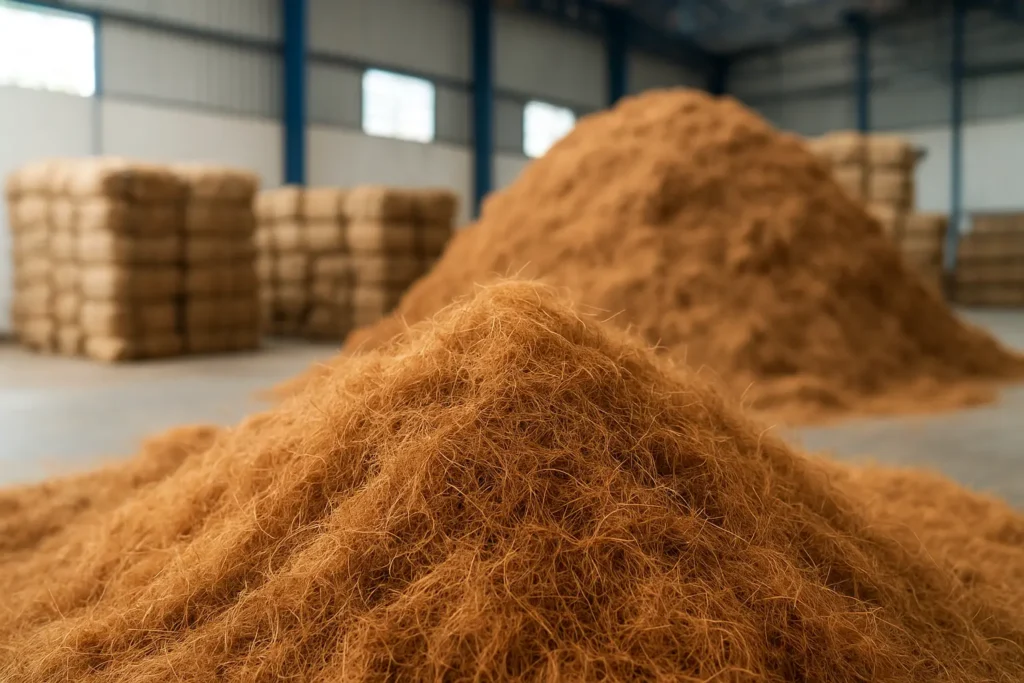
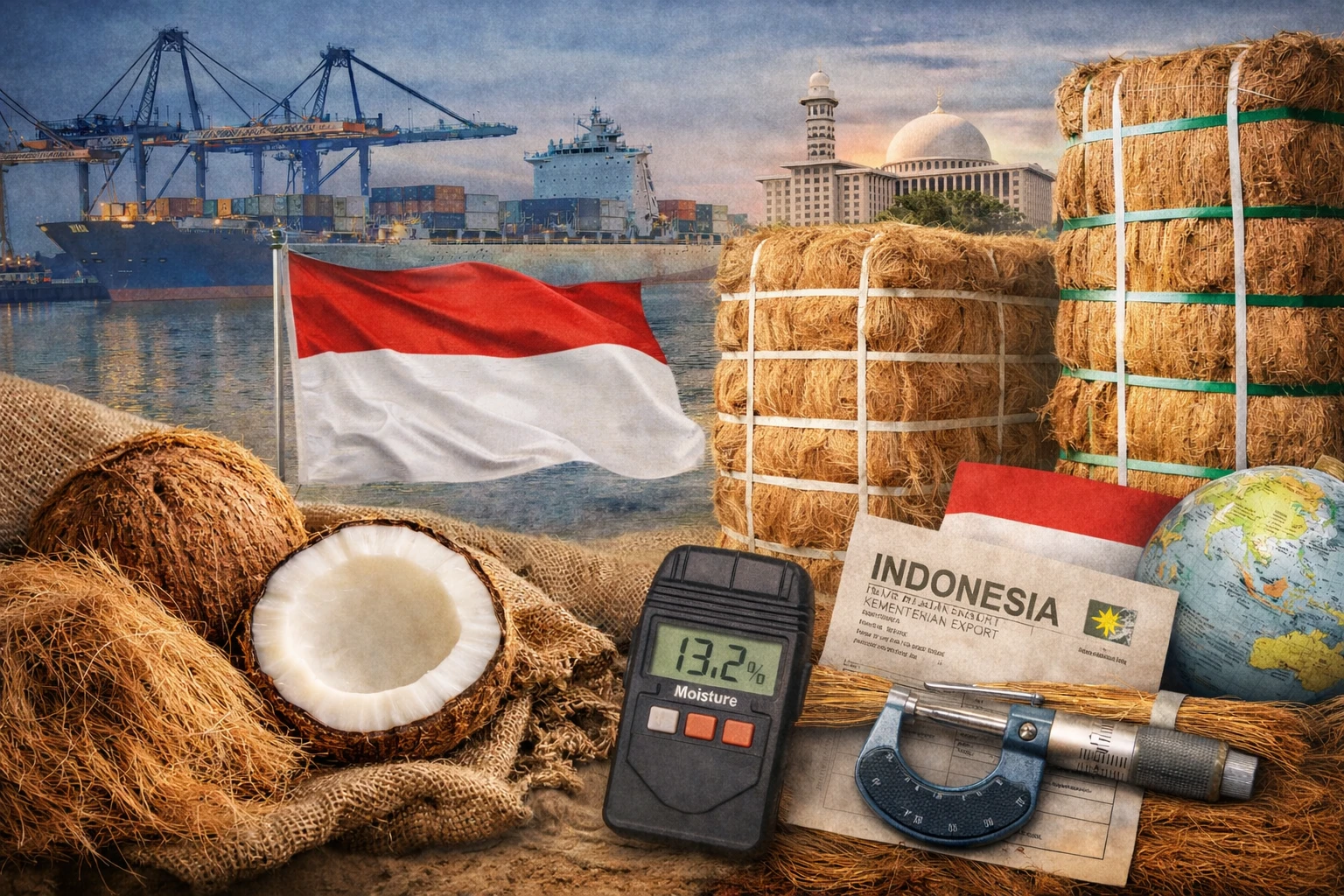
Coconut fiber export specifications play a crucial role in determining product quality, shipment safety, and buyer satisfaction in the global market. For international importers, understanding technical aspects such as moisture content, fiber length, grading, and packaging standards is essential to avoid quality disputes and ensure smooth manufacturing processes.
This guide explains export-grade coconut fiber specifications commonly applied by Indonesian suppliers, helping buyers align technical requirements with real-world supply conditions. If you are still evaluating sourcing origins and want to understand why global buyers prefer coconut fiber from Indonesia, our pillar article provides broader insights into Indonesia’s advantages in quality, sustainability, and export reliability.
QUICK VIEW
Standard Moisture Content for Export-Grade Coir Fiber

Why Moisture Content Matters in Coconut Fiber Exports
Moisture content is one of the most critical quality parameters in coconut fiber exports because it directly affects product stability during storage and transportation. Excess moisture can trigger mold growth, unpleasant odors, and microbial activity, which significantly reduce fiber usability for industrial applications.
For international buyers, inconsistent moisture levels often lead to quality disputes, delayed customs clearance, or even shipment rejection. This risk is particularly high for long-distance shipping routes to Europe, East Asia, and the Middle East.
As a result, moisture control is not only a technical requirement but also a key trust indicator that buyers use to evaluate supplier professionalism and export readiness.
Recommended Moisture Levels for International Shipping
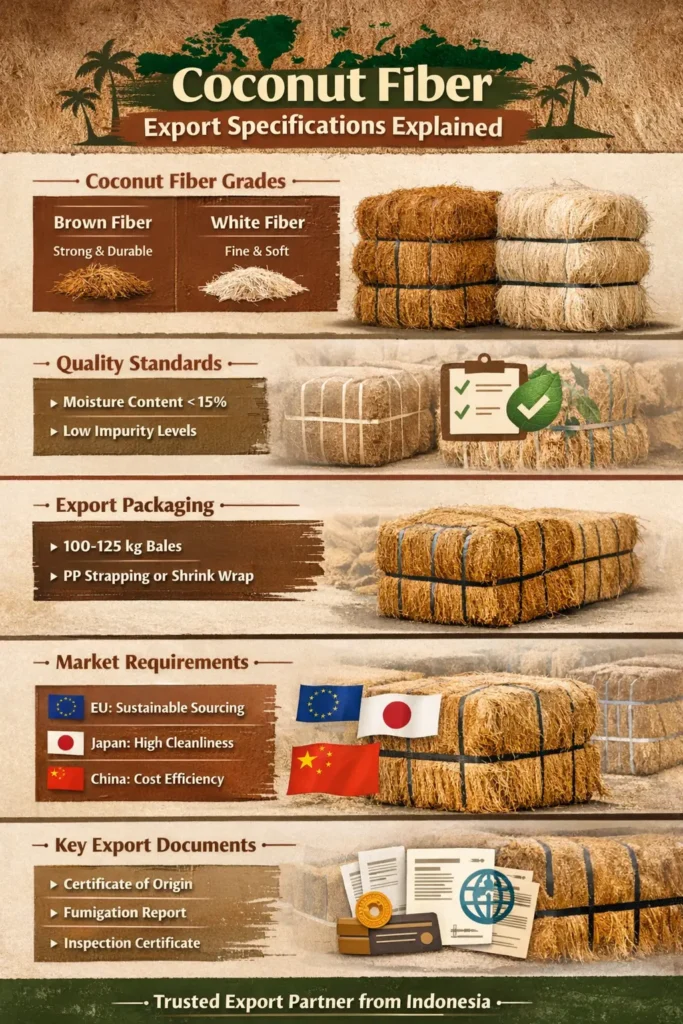
Export-grade coconut fiber is generally required to have a moisture content below 15 percent. This threshold is widely accepted across global markets as it minimizes biological degradation while maintaining fiber flexibility and strength.
Some buyers, especially in Japan and the European Union, may request stricter limits ranging between 10 and 12 percent. These tighter specifications are often applied for high-precision manufacturing such as mattresses, upholstery, and geotextiles.
Clearly defined moisture specifications help both exporters and importers align expectations and reduce the risk of post-arrival quality issues.
How Indonesian Producers Control Moisture During Processing
Indonesian coconut fiber producers primarily rely on natural sun-drying methods supported by controlled handling practices. After fiber extraction, the material is evenly spread and dried under optimal weather conditions to achieve stable moisture reduction.
Once dried, fibers are stored in well-ventilated warehouses to prevent reabsorption of humidity. Proper stacking and floor separation further protect the fiber from ground moisture and condensation.
This combination of traditional drying techniques and disciplined storage management allows Indonesian exporters to maintain consistent moisture levels across large export volumes.
Moisture Testing Methods Used Before Shipment
Before packing and shipment, moisture levels are checked through random sampling using digital moisture meters. These tools provide quick and accurate readings, allowing quality control teams to verify compliance with buyer specifications.
For high-value or contract-based shipments, buyers may request third-party inspections such as SGS or independent surveyors. These inspections include moisture verification as part of the overall quality assessment.
Documented moisture testing builds transparency and reassures buyers that the shipment meets agreed export standards.
Common Moisture-Related Issues Faced by Importers
One of the most common issues faced by importers is container sweating, where temperature differences during transit cause condensation inside the container. This condition can reintroduce moisture to otherwise compliant fiber.
Other problems include fiber clumping, mold spots, and changes in odor, which reduce material usability and increase processing costs for buyers. These issues often result in claims or renegotiation requests.
Consistent moisture control at the source, combined with proper packaging and container handling, is essential to minimizing these risks and ensuring smooth international transactions.
Fiber Length and Grading (Brown vs White Fiber)
Understanding Coconut Fiber Length Specifications
Coconut fiber length is a key specification that determines the fiber’s strength, flexibility, and suitability for different industrial applications. Export-grade coir fiber generally ranges from 5 to 25 centimeters, depending on the extraction and processing methods used.
Longer fibers are typically preferred for applications that require higher tensile strength, such as ropes, geotextiles, and erosion control products. Shorter fibers, on the other hand, are more suitable for brushes, padding, and composite materials.
For international buyers, clearly defined fiber length specifications help ensure compatibility with machinery and reduce inconsistencies in the production process.
Brown Fiber vs White Fiber: Key Differences
Brown fiber is extracted from fully matured coconuts and is known for its durability, stiffness, and resistance to abrasion. It has a natural brown to golden color and is widely used in heavy-duty industrial applications.
White fiber is derived from immature coconuts and has a lighter color with a finer and smoother texture. While it is less durable than brown fiber, white fiber offers greater flexibility and a cleaner appearance.
These fundamental differences make brown and white fibers suitable for distinct markets, and buyers typically specify the type based on their end-product requirements.
Applications Based on Fiber Length and Type
Long brown fibers are commonly used in products such as ropes, nets, geotextiles, and erosion control mats due to their high tensile strength and resistance to environmental stress. These applications demand fibers that can withstand continuous pressure and outdoor exposure.
Shorter brown fibers are often used for mattress filling, upholstery padding, and rubberized coir sheets. Their resilience and ventilation properties make them ideal for comfort-focused products.
White fibers are frequently applied in matting, brushes, and decorative items, where visual appearance and flexibility are more important than extreme strength.
How Fiber Grading Affects Manufacturing Efficiency
Fiber grading refers to the classification of coconut fiber based on length, cleanliness, color consistency, and moisture level. Consistent grading ensures uniform material input for manufacturing processes.
For industrial buyers, well-graded fiber reduces machine downtime caused by tangling or uneven feeding. It also minimizes material waste and improves overall production efficiency.
Reliable grading systems allow manufacturers to maintain consistent product quality, which is essential for large-scale and export-oriented operations.
Buyer Preferences for Specific Fiber Grades
Buyers in the European Union and Japan generally prefer tightly graded fibers with minimal variation in length and impurity levels. These markets emphasize precision, consistency, and compliance with technical specifications.
Chinese buyers often focus on stable supply volumes while maintaining acceptable grade standards for mass production. Flexibility in grading options can be a competitive advantage in this market.
Understanding these market-specific preferences enables Indonesian exporters to tailor fiber grades and strengthen long-term buyer relationships.
Impurity Control and Cleaning Process
What Counts as Impurities in Coir Fiber Exports
In coconut fiber exports, impurities refer to any foreign materials that reduce fiber purity and performance. Common impurities include dust, sand, soil particles, hard shell fragments, and residual pith attached to the fibers.
Excessive impurities can interfere with manufacturing processes and damage processing equipment. For this reason, most international buyers define maximum impurity tolerance levels in their technical specifications.
Clear impurity definitions help exporters and buyers align quality expectations before shipment, reducing the risk of disputes upon delivery.
Cleaning and Separation Techniques Used by Indonesian Exporters
Indonesian exporters apply a combination of manual and mechanical cleaning techniques to achieve export-grade fiber quality. Manual sorting removes large contaminants, while mechanical beating helps separate fibers from remaining pith and shell residues.
Screening and sieving processes are used to filter fine particles such as dust and sand. In some cases, fibers may also be lightly washed to further reduce surface impurities.
These layered cleaning methods allow Indonesian suppliers to produce fibers that meet the cleanliness requirements of different global markets.
Importance of Low Impurity Levels for Industrial Buyers
Low impurity levels are critical for industrial buyers because they directly affect production efficiency. Clean fibers feed more smoothly into machinery, reducing blockages and mechanical wear.
High impurity content often leads to increased processing costs, additional cleaning steps, and higher material waste. For large-scale manufacturers, these inefficiencies can significantly impact operating margins.
By sourcing low-impurity coconut fiber, buyers can maintain stable production output and consistent product quality.
Quality Inspection Standards Before Packing
Before packaging, coconut fibers undergo quality inspections to verify cleanliness, grading, and overall condition. These inspections typically involve visual checks and random sampling conducted by internal quality control teams.
For export shipments, buyers may also request third-party inspections to validate impurity levels and overall compliance. Inspection results are often documented and shared as part of export documentation.
Consistent inspection procedures ensure that only compliant fibers are packed and shipped, minimizing quality-related issues after arrival.
How Clean Fiber Impacts Buyer Trust and Repeat Orders
Clean and consistent fiber quality is a key factor in building buyer trust. When shipments consistently meet agreed impurity standards, buyers gain confidence in the supplier’s quality control capabilities.
This reliability reduces the need for extensive incoming inspections and lowers the risk of production disruptions. Over time, consistent cleanliness encourages repeat orders and long-term supply agreements.
For Indonesian exporters, maintaining high cleaning standards is not only a quality requirement but also a strategic advantage in competitive global markets.
Export Packaging Types (Bales, Weight, Wrapping)
Common Bale Sizes and Weight Standards
Coconut fiber for export is commonly packed in compressed bales to optimize handling and transportation. Standard bale weights typically range between 100 and 125 kilograms, depending on buyer requirements and container loading preferences.
Uniform bale sizes simplify container planning and warehouse storage for importers. Consistent weight standards also help buyers estimate landed costs more accurately.
Some buyers may request customized bale weights to match local handling equipment or labor regulations at the destination port.
Compression Techniques for Container Optimization
Compression is a critical step in coconut fiber export packaging, as it maximizes container space utilization. Properly compressed bales allow exporters to load higher volumes without compromising fiber quality.
Advanced compression techniques ensure that fibers retain their structural integrity while reducing bale dimensions. This balance is essential to prevent fiber damage during long-distance shipping.
Optimized compression directly contributes to lower freight costs per unit, which benefits both exporters and buyers.
Packaging Materials: PP Strapping vs Shrink Wrapping
PP strapping is widely used to secure coconut fiber bales due to its strength and cost efficiency. It provides reliable bale stability during stacking and container loading.
Shrink wrapping offers additional protection by covering the entire bale, reducing exposure to moisture and external contaminants. This method is often preferred for high-value shipments or routes with humid transit conditions.
The choice between PP strapping and shrink wrapping depends on buyer specifications, shipping distance, and environmental factors.
Labeling and Marking for Export Identification
Proper labeling is essential for export identification and traceability. Each bale is typically marked with key information such as product type, weight, batch number, and country of origin.
Clear and consistent labeling facilitates customs clearance and inventory management at the destination. It also reduces the risk of misidentification during transshipment.
Many buyers include specific labeling requirements in their contracts to ensure smooth logistics and documentation alignment.
How Proper Packaging Prevents Damage During Transit
Proper packaging protects coconut fiber from physical damage, moisture exposure, and contamination during transit. Secure bales are less likely to shift or collapse inside containers.
Well-packaged fiber also minimizes the risk of container sweating and pressure-related deformation. This is especially important for long-haul shipments across varying climate zones.
By investing in robust packaging practices, exporters can preserve fiber quality and reduce the likelihood of claims or disputes upon delivery.
Common Buyer Requirements by Country (EU, Japan, China)
European Union Standards and Sustainability Expectations
Buyers in the European Union place strong emphasis on sustainability, environmental responsibility, and traceability. Coconut fiber supplied to this market is often expected to come from eco-friendly production processes with minimal chemical use.
Compliance with sustainability frameworks and responsible sourcing practices enhances supplier credibility. Many EU buyers also value transparent supply chains that demonstrate social and environmental accountability.
Meeting these expectations allows Indonesian exporters to align with Europe’s growing demand for natural and biodegradable materials.
Japanese Market Preferences for Consistency and Cleanliness
The Japanese market is known for its strict quality requirements and low tolerance for variation. Buyers typically demand highly consistent fiber length, moisture content, and cleanliness across every shipment.
Even minor deviations from agreed specifications may result in shipment rejection or requests for corrective action. Detailed technical documentation and clear communication are essential when supplying this market.
Exporters who consistently meet Japanese standards often benefit from long-term partnerships and stable demand.
Chinese Buyer Focus on Volume and Cost Efficiency
Chinese buyers generally prioritize large-volume supply and competitive pricing. Consistent availability and scalable production capacity are key factors in supplier selection.
While quality remains important, buyers may accept broader specification ranges compared to EU or Japanese markets. Flexibility in packaging, grading, and logistics is often appreciated.
This market offers significant opportunities for exporters capable of balancing cost efficiency with acceptable quality standards.
Documentation Required for Different Destinations
Export documentation requirements vary by destination country but typically include Certificates of Origin, fumigation reports, and inspection certificates. Accurate and complete documentation is essential to ensure smooth customs clearance.
Some markets may also require additional declarations related to phytosanitary standards or sustainability compliance. Exporters must stay informed about destination-specific regulations.
Well-prepared documentation minimizes delays, penalties, and potential shipment rejections.
How Indonesian Exporters Adapt to Market-Specific Demands
Indonesian exporters adapt their processing, grading, and packaging methods to meet diverse international buyer requirements. This flexibility allows them to serve multiple markets efficiently.
Integrated logistics support further enables exporters to customize shipping arrangements and documentation. Close coordination between production and logistics teams ensures consistency and reliability.
By responding effectively to market-specific demands, Indonesian suppliers strengthen their position as trusted partners in the global coconut fiber trade.
FAQ About Coconut Fiber Export Specifications
What is the standard moisture content for export-grade coconut fiber?
Export-grade coconut fiber typically has a moisture content below 15%. Some buyers, especially in Europe and Japan, may require stricter limits between 10% and 12% to prevent mold and ensure long-term storage stability.
What is the difference between brown fiber and white fiber in coconut coir?
Brown fiber comes from mature coconuts and is stronger and more durable, making it suitable for industrial uses such as geotextiles and ropes. White fiber is extracted from immature coconuts and is finer, softer, and commonly used for mats, brushes, and decorative products.
What fiber length is required for coconut fiber exports?
Coconut fiber for export usually ranges from 5 to 25 centimeters in length. Longer fibers are preferred for high-tensile applications, while shorter fibers are suitable for mattresses, upholstery, and composite products.
How is coconut fiber cleaned before export?
Coconut fiber is cleaned using manual sorting, mechanical beating, and screening to remove dust, sand, and shell residues. Some exporters also use light washing processes to achieve lower impurity levels based on buyer specifications.
What packaging is commonly used for coconut fiber exports?
Coconut fiber is typically packed in compressed bales weighing between 100 and 125 kilograms. Packaging methods include PP strapping and shrink wrapping, depending on buyer requirements and shipping conditions.
Which documents are required for exporting coconut fiber from Indonesia?
Common export documents include a Certificate of Origin, fumigation report, packing list, commercial invoice, and inspection certificate. Additional documents may be required depending on the destination country.
Why do buyers prefer coconut fiber from Indonesia?
Buyers prefer Indonesian coconut fiber due to consistent quality, competitive pricing, sustainable production practices, and reliable export logistics. Indonesia also offers flexible specifications to meet diverse international market requirements.
Final Thoughts on Coconut Fiber Export Specifications
Understanding coconut fiber export specifications is essential for international buyers seeking consistent quality, smooth logistics, and long-term supply reliability. Factors such as moisture content, fiber length, impurity control, packaging standards, and market-specific requirements directly influence product performance and shipment success.
Indonesian exporters have developed strong capabilities in meeting these technical standards through disciplined processing, quality control, and flexible export handling. This adaptability allows buyers from different regions to source coconut fiber that aligns with both industrial needs and regulatory expectations.
If you are still exploring sourcing origins and want a broader perspective, we recommend reading why global buyers prefer coconut fiber from Indonesia to understand the country’s competitive advantages in sustainability, quality, and export reliability.
To explore available product options and specifications, you can also visit our coconut fiber product category and find solutions tailored to your industry requirements.
Trusted References
Nissar, M., Chethan, K. N., Anantsagar Birjerane, Y., Patil, S., Shetty, S., & Das, A. (2023). Coconut Coir Fiber Composites for Sustainable Architecture: A Comprehensive Review of Properties, Processing, and Applications. Journal of Composite Science, 9(10). https://doi.org/10.3390/jcs9100516
Ramadhani, M. R., Rahmawati, R., Wibowo, R., & Arrohman, S. (2025). Analisis Variasi Serat Terhadap Sifat Fisik dan Mekanik Komposit Hybrid dari Serat Sabut Kelapa, Fiberglass, dan Epoxy. Jurnal Teknik Mesin, Elektro dan Ilmu Komputer, 5(2). https://doi.org/10.55606/teknik.v5i2.7598