
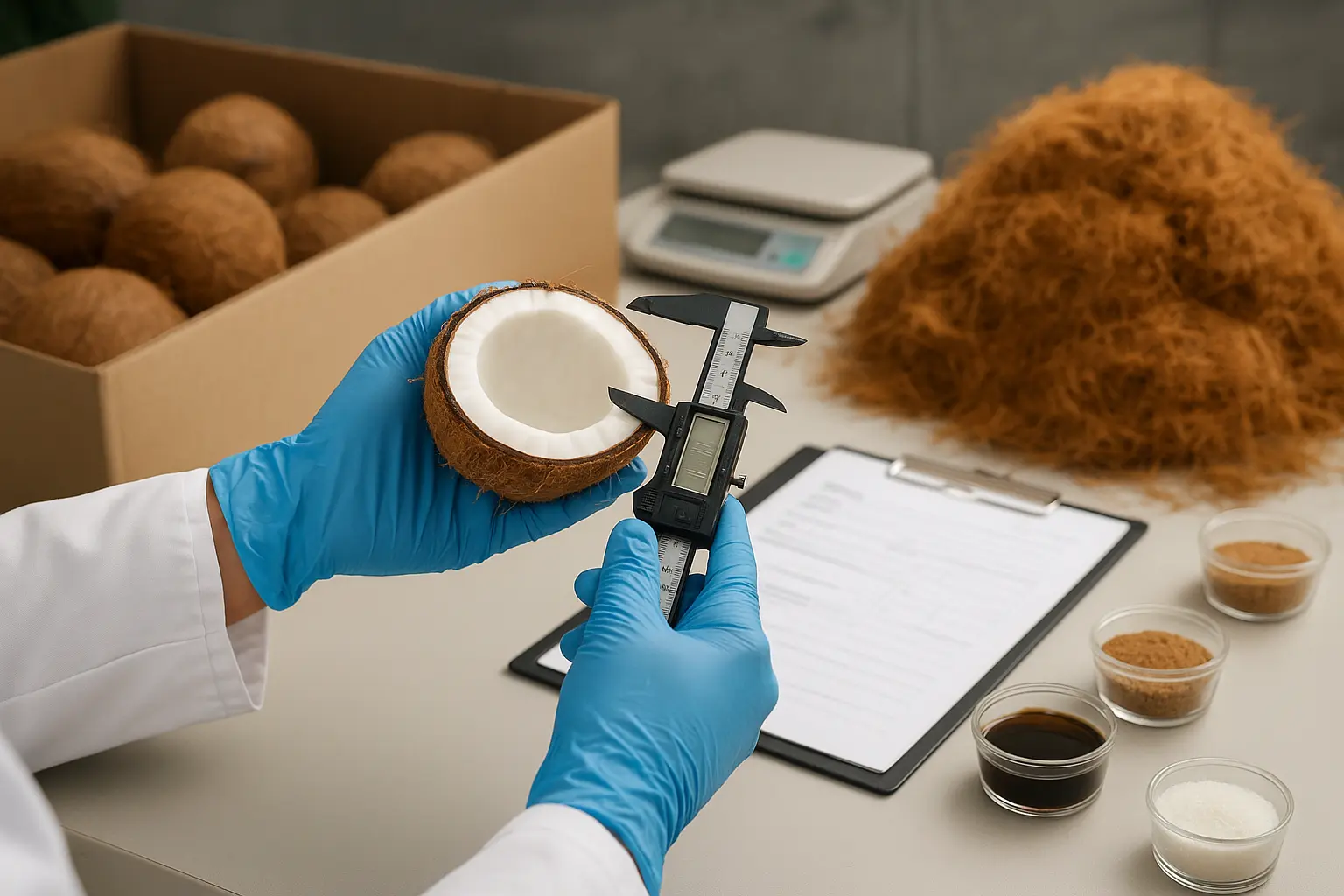
Maintaining export-grade quality is one of the most crucial aspects of international trade, especially in the coconut industry where moisture, purity, and packaging standards directly affect buyer confidence. At Madika Coconut Indonesia, quality control is not just a process — it is a culture rooted in precision, consistency, and sustainability.
Through integrated logistics, certified inspections, and careful material handling, Madika Coconut guarantees that every shipment meets international expectations. This article explores how our company upholds quality at every stage — from raw material selection to export documentation and global delivery.
Quick View
Quality Control Process at Madika Coconut
Our commitment to export-grade quality begins long before production. Each coconut-based material, whether fiber, charcoal, or oil, undergoes rigorous selection to ensure it meets physical and chemical specifications required for international trade.
Watch this short video to see how Indonesian coconut shell and fiber products undergo quality control and export preparation in real time.

Raw Material Selection
Madika Coconut sources coconuts from verified plantations across Indonesia, emphasizing sustainable farming and consistent maturity levels. This guarantees uniform raw material that supports quality and long-term reliability.
Our procurement team ensures moisture content and fiber density align with export standards before any processing begins. All batches are tested for contamination or mold to eliminate risks early in production.
This early-stage verification minimizes defects and allows us to maintain product integrity across large export volumes.
Processing and Drying Standards
Each product category — such as coir fiber, cocopeat, or charcoal briquettes — has its own quality benchmarks. We maintain drying temperatures between 80–100°C to achieve consistent low moisture levels (below 15% for fiber and below 10% for charcoal).
Industrial drying and screening units are calibrated periodically to maintain accuracy. For coconut oil and sugar derivatives, cold-press or vacuum processes preserve purity and reduce oxidation.
Every process stage is logged digitally, allowing transparent traceability for every container batch exported.
Pre-Shipment Inspection and Certification
Before any shipment leaves Indonesia, products are inspected internally and by third-party agencies such as SGS or Sucofindo. These inspections verify weight, packaging, and moisture control to ensure each container meets buyer specifications.
Certificates such as Certificate of Analysis (COA), Phytosanitary Certificate, and Certificate of Origin accompany every export. Buyers can also request custom documentation such as fumigation or quality reports.
This multilayer inspection approach enhances transparency and trust, ensuring repeat business and long-term partnerships.
Product Categories with Export-Grade Standards
Coconut Fiber and Coir Products
All coir products are graded by color, fiber length, and impurity percentage. Brown fiber is compressed into uniform bales, while cocopeat is sieved and classified into Low EC and High EC grades depending on electrical conductivity levels.
Fiber bundles undergo double pressing to ensure maximum density, which reduces container space and shipping cost. Each bale is wrapped with PP straps for stability during transport.
Products are stored in ventilated warehouses with controlled humidity to preserve their natural quality before shipment.
Coconut Charcoal and Briquettes
Our briquettes are produced from 100% coconut shell charcoal with fixed carbon above 80% and ash below 3%. The materials are ground, mixed with food-grade binder, pressed into cubes or hexagonal shapes, and dried under controlled temperature.
Every batch is tested for ignition time, ash color, and burning duration to meet shisha and BBQ market requirements. Quality reports accompany each palletized carton for full traceability.
Packaging is done in moisture-proof cartons with clear labeling for destination ports and HS codes.
Coconut Oil, Sugar, and Derivatives
For liquid products like Crude Coconut Oil (CNO) and Virgin Coconut Oil (VCO), we ensure acid value and FFA levels meet global standards. Laboratory results are attached to each batch for export transparency.
Organic coconut sugar and syrup are processed under strict temperature control to maintain nutrient content and prevent crystallization. Product color and taste consistency are verified through random sampling.
All edible products are handled in HACCP-certified facilities to guarantee food-safety compliance.
Logistics and Handling Integrity
Partnering with Madika Trans Indonesia enables Madika Coconut to maintain control of product movement from factory to port. This integrated model eliminates the risks associated with third-party handling.
Containers are sealed immediately after inspection, with photographs and documentation shared with buyers. Shipments use moisture-absorbent packs and palletized loading to prevent damage from tropical humidity during transit.
Each container is tracked through digital systems, allowing clients to monitor progress and estimated time of arrival (ETA) in real time. This level of transparency ensures accountability at every step of the export journey.
Environmental Responsibility and Sustainability
Quality is inseparable from sustainability. Madika Coconut implements eco-friendly production by minimizing waste and reusing coconut by-products for bio-energy and compost.
Our facilities follow environmental management systems aligned with ISO 14001 principles, ensuring compliance with global sustainability expectations. We support community-based sourcing that empowers local farmers through fair-trade practices.
These initiatives make every Madika Coconut shipment not only consistent in quality but also ethical and environmentally responsible.
FAQ – Export-Grade Coconut Quality
What defines export-grade coconut products?
Export-grade coconut products meet strict moisture, impurity, and packaging standards suitable for long-distance shipping and international compliance requirements.
How does Madika Coconut ensure consistent quality?
Madika Coconut follows a multi-step inspection system covering raw material selection, processing control, and third-party verification by SGS or Sucofindo.
Are Madika Coconut products certified for food safety?
Yes. Edible products like coconut oil and sugar are processed in HACCP-certified facilities and tested for purity and compliance with international standards.
Can buyers request custom inspection before shipment?
Absolutely. Buyers can appoint third-party surveyors to conduct pre-shipment inspection or sampling. Madika Coconut fully supports transparent verification.
Final Reflections
Export-grade quality is not achieved overnight — it is built through discipline, transparency, and continuous improvement. Madika Coconut Indonesia integrates these principles into every shipment, ensuring that global buyers receive consistent, certified, and sustainable products.
By partnering with Madika Coconut, importers gain a trusted ally that understands both the production and logistics sides of international trade. Every container leaving our facilities represents Indonesia’s excellence in the global coconut industry.
Learn more about our operations on the About Us page, explore our full Product Catalog, or start your partnership today by visiting our Request a Quote page.